Why Using Props in Yoga Isn’t Cheating
Key Takeaways
Props aren’t a sign of limitation.
Blocks, straps, bolsters and blankets help us adapt the practice to our individual bodies and can make poses more accessible, stable and effective.Using support can be part of the practice.
Choosing a prop asks us to listen to what our body needs rather than being driven by comparison, achievement or ego. Sometimes, accepting support is the most skilful choice we can make.There is no single “perfect” version of a pose.
Yoga is about developing awareness of our own bodies, rather than trying to make our bodies fit a particular shape.
I can almost guarantee you the first reason someone will give you for why they don’t practise yoga is because they cannot touch their toes.
Somewhere along the way, many of us were given the idea that yoga is something you have to be naturally flexible, strong or slim to do. Perhaps it is the narrow view that the media has often shown us of people wrapping themselves into seemingly impossible shapes in advanced poses. Or perhaps it is the size and shape of the bodies we traditionally see represented in yoga.
Whatever the reason, it has done a very good job of making people feel that yoga is not for them.
I’m grateful for the teachers who have thought differently and who have helped make yoga a more inclusive and approachable practice, one that can meet every BODY exactly where it is.
Inclusive Yoga and Pose Modification
When I was training as a student teacher, my teacher told us that we would eventually have to decide what style of yoga we wanted to teach.
For me, that decision came back to my values.
I wanted my teaching to reflect my belief that everybody should feel included, comfortable and seen. I wanted yoga to be something that people could actually experience in their own bodies, rather than something they felt they had to be flexible enough, strong enough or experienced enough to achieve.
That is why I teach in a way that offers variations and modifications. Whether you are completely new to yoga or have been practising for years, the practice can meet you at the level that feels appropriate for your body that day.
Props are not a sign that you’re not good at Yoga
We can sometimes fall into the idea that using a block makes a pose less challenging, or somehow means we aren’t capable enough to do it without one.
There can be an unspoken idea that the person who can reach the floor without a block is somehow doing the “better” version of the pose.
But yoga isn't a competition to see how close you can get to the floor.
A block doesn't make the pose easier in the way we sometimes assume. It can actually make the pose more effective.
The functional benefits of Yoga Props
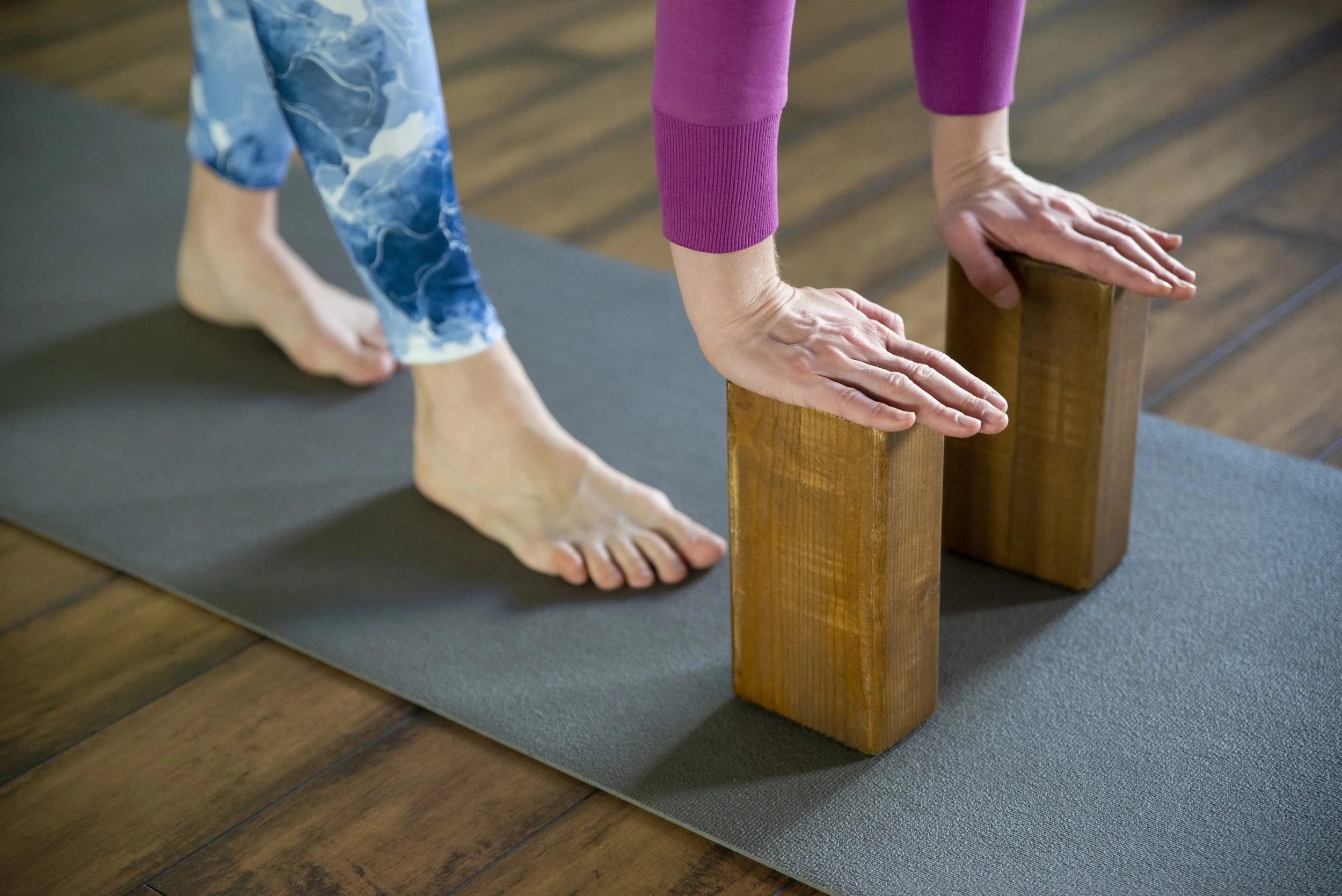
Props such as blocks, bricks, straps, bolsters and blankets allow us to adapt the practice to the body we have, rather than forcing our body to fit the pose.
They can help us find better alignment, create stability, support our joints, improve our range of motion and sometimes even make us work harder.
Take Triangle Pose, for example.
I often see students reaching for the floor with their bottom hand and, because they cannot comfortably reach it, bending the front knee to get there.
But touching the floor isn't the goal.
By placing a block underneath the hand, you effectively bring the ground closer to you. This can allow the front leg to remain straighter, while giving you enough height to rotate through the upper body and create more space across the chest and side body.
The block hasn't made the pose “lesser”.
It has changed the relationship between your body and the floor so that you can experience the pose more fully.
And sometimes that is exactly what we need.
Props can also provide support where our bodies need it most.
A blanket underneath the knees can make a kneeling position more comfortable. A block can provide stability when our balance isn't quite there. A bolster can support the body in restorative poses, allowing the muscles to soften rather than constantly working to hold us in position.
This is particularly important when we are working with limited mobility, previous injuries, stiffness or simply a body that doesn't move in the same way as somebody else's.
There is no prize for forcing yourself into a range of motion that your body isn't ready for.
Yoga asks us to develop awareness of our bodies, to notice sensation, breath, effort and ease. Props can help us do that with greater clarity.
Props aren't only there to make a pose more comfortable.
They can also be used to increase muscle engagement and develop strength.
For example, placing a block between the thighs and gently squeezing it can help us engage the muscles of the inner thighs, creating greater awareness and stability through the legs and pelvis.
A block can also be used as something to press into, creating resistance and helping us understand where and how we are engaging our muscles.
Sometimes the prop isn't taking work away from the body.
It's helping the body find the right work.
Overcoming Ego in Your Yoga Practice
And then there is the ego
I think this is where yoga gets really interesting.
Our ego can have a lot to say about how we practise.
We want to achieve the pose. We want to get deeper. We want to straighten the leg. We want our hands to reach the floor. We look around the room and, without even realising it, compare ourselves with the person next to us.
And sometimes we push beyond what our body can safely manage because we want to prove that we can.
But the purpose of yoga isn't to accomplish a shape at any cost.
There is always a risk of injury when we lack the flexibility, stability or strength required for a particular position and continue to force ourselves into it anyway.
Using a prop can sometimes require us to put the ego to one side and acknowledge what our body actually needs.
And that, in itself, is part of the practice.
There’s no perfect version of a pose
I don't believe there is one perfect way to do a yoga pose.
Every body is different. Our proportions are different. Our bone structure is different. Our flexibility, strength, mobility and previous experiences are different.
Even within the same body, a pose can feel completely different from one day to the next.
Instead of trying to perfect a pose, yoga invites us to develop body awareness.
Can you feel what is happening?
Can you distinguish between a useful stretch and a sensation that tells you to back off?
Can you feel whether you are actually strengthening the muscles the pose is asking you to engage?
Can you breathe?
Can you create stability without gripping?
Support isn’t a weakness
So are props cheating?
No.
If anything, I think refusing to use a prop because you believe you shouldn't need one can sometimes be the bigger obstacle.
A prop is simply a tool.
You wouldn't refuse to wear glasses because you thought you should be able to see without them. You wouldn't refuse a handrail because you thought you should be able to climb the stairs without support.
So why do we treat support in yoga as a weakness?
The next time your teacher offers you a block, strap, bolster or blanket, try seeing it differently.
Don't think of the prop as something that takes you away from the pose.
Think of it as something that helps bring the pose to you.
Yoga isn't about making your body fit a shape.
It is about learning to listen to your body, work with it and understand it.
And sometimes, the most skilful thing you can do on your mat is to accept the support that is being offered.
About the Author
Tabitha Ndirangu
Founder of Living in Yoga | Yoga Teacher
Tabitha is a qualified Yoga teacher. She has been teaching yoga for five years, creating approachable and inclusive classes that help people build strength, flexibility and greater awareness of their bodies. Her teaching draws on yoga philosophy, practical movement and her experience working with people of different abilities.