Uncovering the Hidden Roots of Pain
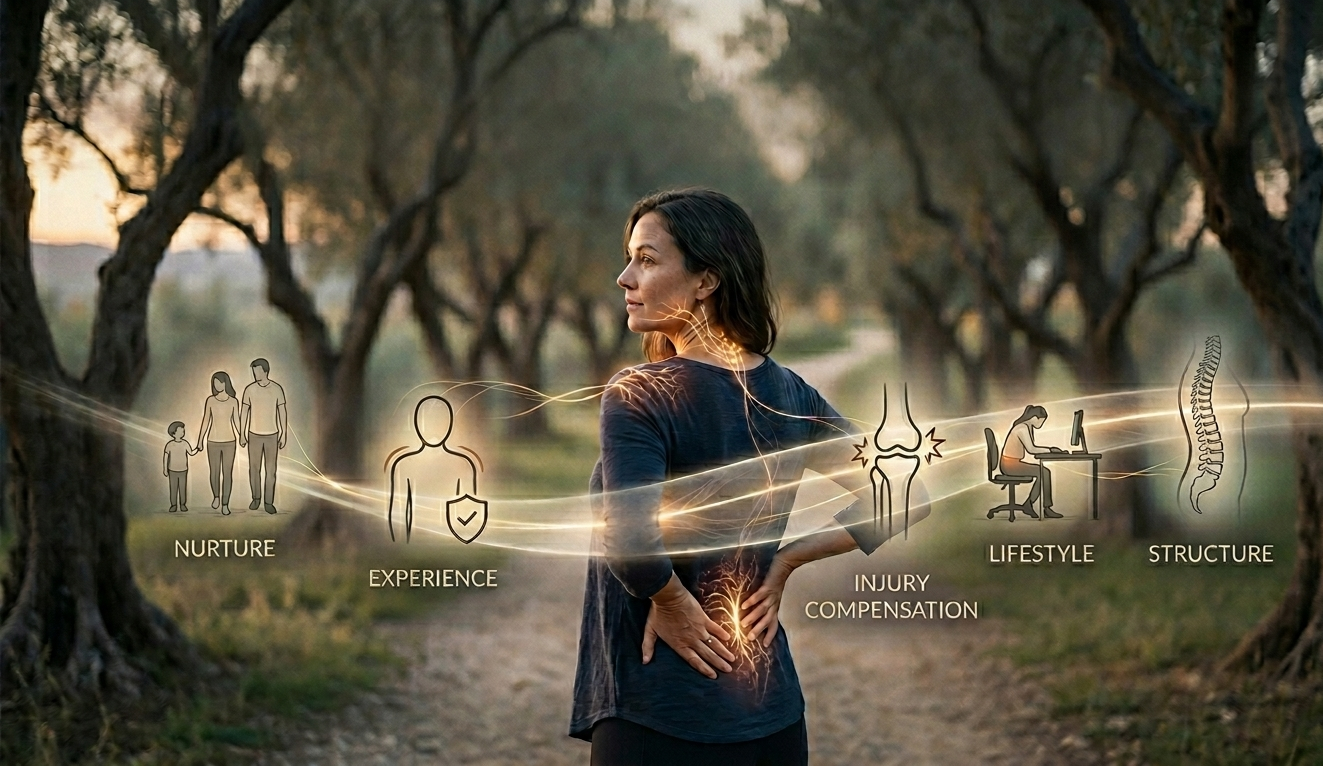
Pain is rarely random; it’s a story written by your history. This infographic maps out how everything from inherited childhood habits (nurture) to modern desk work (lifestyle) creates the physical patterns we feel today.
The Story Your Body Tells
Most people don’t think about their body until something starts to hurt.
A tight lower back. A stiff neck that never quite releases. Hips that ache after a long day of sitting. You stretch, maybe book a massage and hope it goes away.
Sometimes it does. Often, it comes back. This is because pain is rarely random. It’s a message. A pattern. A story your body has been writing over time.
Here is the Story.
How We Learn To Move
We like to believe that the way we move is entirely our own, but much of it was learned long before we were aware. From the moment we’re born, we begin absorbing the world around us. Not just language or behaviour, but posture, tension, and physical habits. The way our parents stand, the way they hold stress in their shoulders, even how they breathe; these patterns become familiar to a young child, and this familiarity becomes the norm.
Before we consciously choose how we move, our body has already been shaped by what it has seen.
The Body as a Record of Experience
The body doesn’t just carry muscle and bone, it carries experience. Stress, fear, and emotional strain don’t simply disappear once a moment has passed. They leave traces, and the body adapts in subtle, protective ways.
“Studies of individuals who have experienced trauma suggest that emotional stress and dissociation can alter postural control and balance, supporting the idea that lived experience can show up in the body’s movement patterns.”
Someone who has lived in a high-stress environment may hold constant tension in the shoulders or jaw. Someone who learned to stay small or unnoticed may round forward without realising it. These aren’t conscious choices; they are adaptations. Over time, those adaptations become posture. And the imbalance of this adaptation can contribute to discomfort.
The Effect of Injury
Injury adds another layer to the story. When the body is hurt, it finds ways to protect itself. If one area becomes vulnerable, another takes on more work. You shift your weight, adjust your gait, and compensate without thinking.
What starts as protection can turn into overload. Muscles that were never meant to carry that burden begin to fatigue. Pain appears in places that seem unrelated to the original injury.
“The pain issue isn’t always where you feel it; it’s often where the pattern began.”
The Modern Environment
Then there’s the way we live.
Our bodies were designed for movement, yet most of us spend hours each day sitting at desks, in cars, on sofas. Over time, this creates a very specific pattern in the body.
The front of the hips tightens. The glutes and hamstrings become underused and weak. And because the body works as a whole system, a lack of movement in one area creates strain in another. A restriction in the hips can show up as tension in the spine.
A systematic review of five studies found that the longer we sit in static positions, the more likely we are to experience pain in various parts of the body.
What We’re Born With
But not all pain is learned or accumulated over time. Some of it begins with the body we are born into.
Structural differences such as scoliosis, leg-length discrepancies, or variations in joint shape can influence how the body distributes weight and moves through space from the very beginning. These differences don’t always cause pain immediately, but over time, they can create uneven loading through the muscles and joints.
The body adapts, as it always does. But those adaptations can lead to tension, imbalance, and discomfort later in life.
“Pain is not always a result of something you did wrong. Sometimes it reflects the unique structure and physiology of your body. The goal then becomes to understand it, support it, and work with it.”
Other Factors that Influence Pain
Beyond structure, experience, and lifestyle, there are other factors that can shape how pain shows up in the body.
Inflammatory conditions, such as arthritis, can create persistent discomfort regardless of movement patterns. Hormonal changes can influence joint stability and sensitivity. Even sleep quality and stress levels can alter how the body perceives and processes pain.
In Summary
When you look at pain in these different ways, it stops being something to “fix” and starts being something to understand.
Your body is not working against you; it’s responding to everything it has experienced:
What it learned
What it protected against
What it adapted to, and
How you live now.
A Simple Place to Start
Awareness is powerful, but so is action.
If you’re spending long hours sitting, small, consistent movements can make a significant difference in how your body feels.
I’ve put together a short video with three simple ways to release tension from sitting and bring your body back into balance.
Watch: 3 simple movements to release sitting tension
Prins Y, Crous L, Louw QA. A systematic review of posture and psychosocial factors as contributors to upper quadrant musculoskeletal pain in children and adolescents. Physiother Theory Pract. 2008 Jul-Aug;24(4):221-42. doi: 10.1080/09593980701704089. PMID: 18574749.